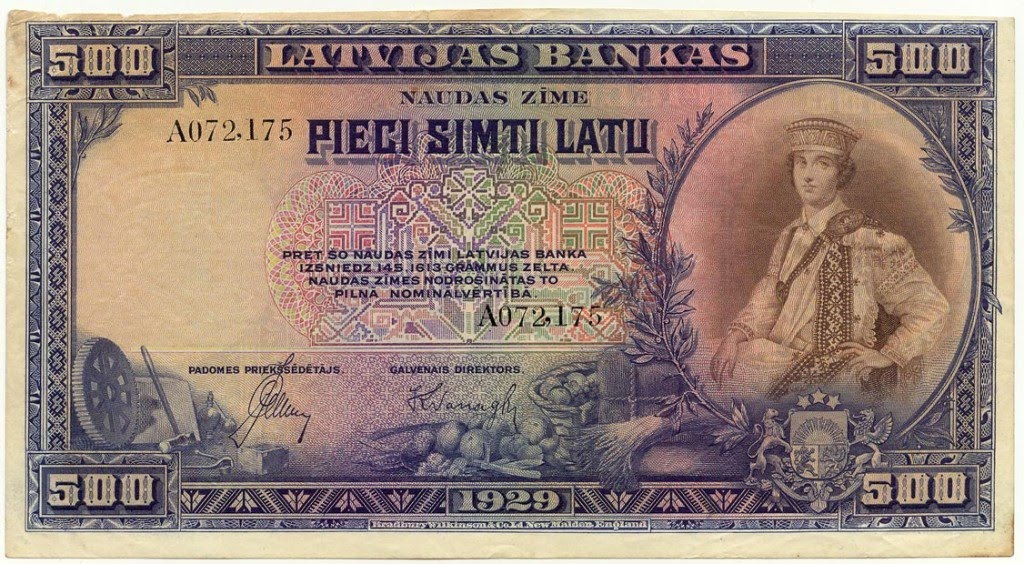
Latvia banknotes 500 LATU banknote of 1929, Bank of Latvia.

Latvia 500 Latu Latvian Lats Milda banknote money currency
Latvian Lats banknote with the highest face value 500 Latu
Latvia 500 Latu lats bill Rare paper money
 Latvia 500 Latu banknote
Currency of Latvia 500 Latu - Latvian Lats banknote of 1929, issued by the Bank of Latvia.
Latvian banknotes, Latvian bank notes, Latvian paper money, Latvia banknotes, Latvia bank notes, Latvia paper money

Obverse: Portrait of a Latvian lady wearing a folk costume, with a brooch on her left shoulder. The lady pictured on the banknote is Milda, the personification of Latvia. Milda - goddess of love and freedom (Baltic mythology). Across the top of the banknote, there is the tree inscription LATVIJAS BANKAS naudas zime (Money note of the Bank of Latvia) and PIECI SIMTI LATU (Five hundred Lats).
Reverse: Rural scene - Cows and sheaves.
Printed by Bradbury Wilkinson and Company, New Malden in Surrey, England.

20 Latu banknote - 1925 issue

Latvia banknotes 20 Latvian Lats Latu, President of Latvia Janis Cakste
 Latvia 20 Latvian Lats banknote 
Latvijas Banka 20 Latu Lati banknote
Latvijas Banka 20 Latu
Latvia 20 Latvian Lats Latu banknote of 1925, issued by the Bank of Latvia.

Obverse: Portrait of Jānis Čakste,1st President of Independent Latvia. Across the top of the banknote, there is the two inscription LATVIJAS BANKAS NAUDAS ZIME (Money note of the Bank of Latvia). The banknote face value is printed in words  ("DIVDESMIT LATU" - Twenty Lats) and there is the numerical indication of the denomination in the four corners of the banknote.
Reverse: The Great Coat of Arms of the Republic of Latvia.
Printed by Waterlow and Sons Limited, London England.

Latvian paper money - 10 Latu - 1933 issue

10 Latvian Lati Latu paper money
10 Latvian Lati
Latvian Lats banknotes 10 Latu
10 Latvian lats Latu
Currency of Latvia 10 Latu - Latvian Lats banknote of 1933, issued by the Latvian Government State Treasury.

Obverse: Seated Latvian lady wearing a national costume with a sheaf of wheat. The lady pictured on the banknote is Milda, the personification of Latvia. Milda - goddess of love and freedom (Baltic mythology). The Great Coat of Arms of the Republic of Latvia and 10 Ls.
Reverse: At the right side of the banknote, there is the inscription LATVIJAS VALSTS KASES ZĪME (Latvian Government State Treasury Notes) and DESMIT LATU (Ten Lats) and the numerical indication of the denomination at the left side.
Printed by Valsts Papiru Spiestuve, Riga Latvia.

On the 15 June 1940 the rate of exchange of the Latvian Lats was as follows:

1 British Pound £  = 29.35 Ls
1 US Dollar          = 5.40 Ls
100 Swiss Francs = 121.25 Ls
100 SEK Swedish Krona = 128.50 Ls
100 German Reichsmark = 205.00 Ls

10 Latu - Latvian Government State Treasury Note - 1925 issue

10 Latu - Latvian Government State Treasury Note - 1925 issue
10 Latu
Front - Oak tree and cornfield on back
10 Latu - Latvian old paper money 1925 issue

1 Lats = 100 Santimu, 1923 - 1940

5 Lati - Latvian Government Exchange note - 1940 issue

Latvia 5 Lati Lats Latvian banknotes
5 Latvian lati
5 Lati Lats Latvian paper money
5 Latvian Lats
Latvia 5 Latvian Lats Lati banknote of 1940.

Obverse: Bridge accross the River Guaja. Across the top of the banknote, there is the two inscription LATVIJAS VALSTS KASES MAINAS ZĪME (Latvian Government Exchange Notes). The banknote face value is printed in words ("PIECI LATI" - Five Lats) and there is the numerical indication of the denomination of the banknote.
Reverse: The Great Coat of Arms of the Republic of Latvia.
Printed by Valsts Papiru Spiestuve un Naudas, Riga Latvia.

100 Rubli - Latvia old banknote - 1919 issue

Latvia currency 100 Latvian rublis banknote Rubli bill
Latvian rubli
Сто Рублей 100 Rubli Rubel Latvia paper money 1919 issue
100 рублей Обязательство Государственнаго Казначейства Латвии
First currency of Latvia 100 Latvian rublis banknote of 1919, issued by the Latvian Government State Treasury.

Obverse: The first Coat of Arms of the State of Latvia. (adopted 2 December 1918 ) was designed by professor Burkards Dzenis. Latwijas Walsts Kaşes Sihme - Simts Rubli (Latvian Government Currency Note - One Hundred Rubli)
Reverse: Oak tree with Coat of Arms of the Republic of Latvia. Across the banknote, there are the inscriptions: Обязательство Государственнаго Казначейства Латвии  100 Сто Рублей -  Lettlands Staats Kassenschein 100 Hundert Rubel.

The Latvian national coat of arms was formed after the proclamation of an independent Latvian Republic. The sun in the the coat of arms symbolises Latvian national statehood. A stylised depiction of the sun was used as a symbol of distinction and national identity by Latvian riflemen – latviesu strelnieki – recruited into the Russian imperial army during WWI. During WWI the sun figure fashioned with 17 rays that symbolised the 17 inhabited Latvian districts. The three stars embody the idea of the inclusion of historical districts (united Kurzeme – Zemgale, Vidzeme and Latgale) into a united Latvia.

1 Rublis = 100 kapeikas, 1919 - 1922

25 Rubli - 1919 issue - Paper Money from Latvia

25 Rubli Paper Money Latvia
25 Rubli Latvia banknote